Vendor proposal capability is also shifting from "mastery of feature implementation" to "understanding the entire business value chain and envisioning where to apply leverage for growth".
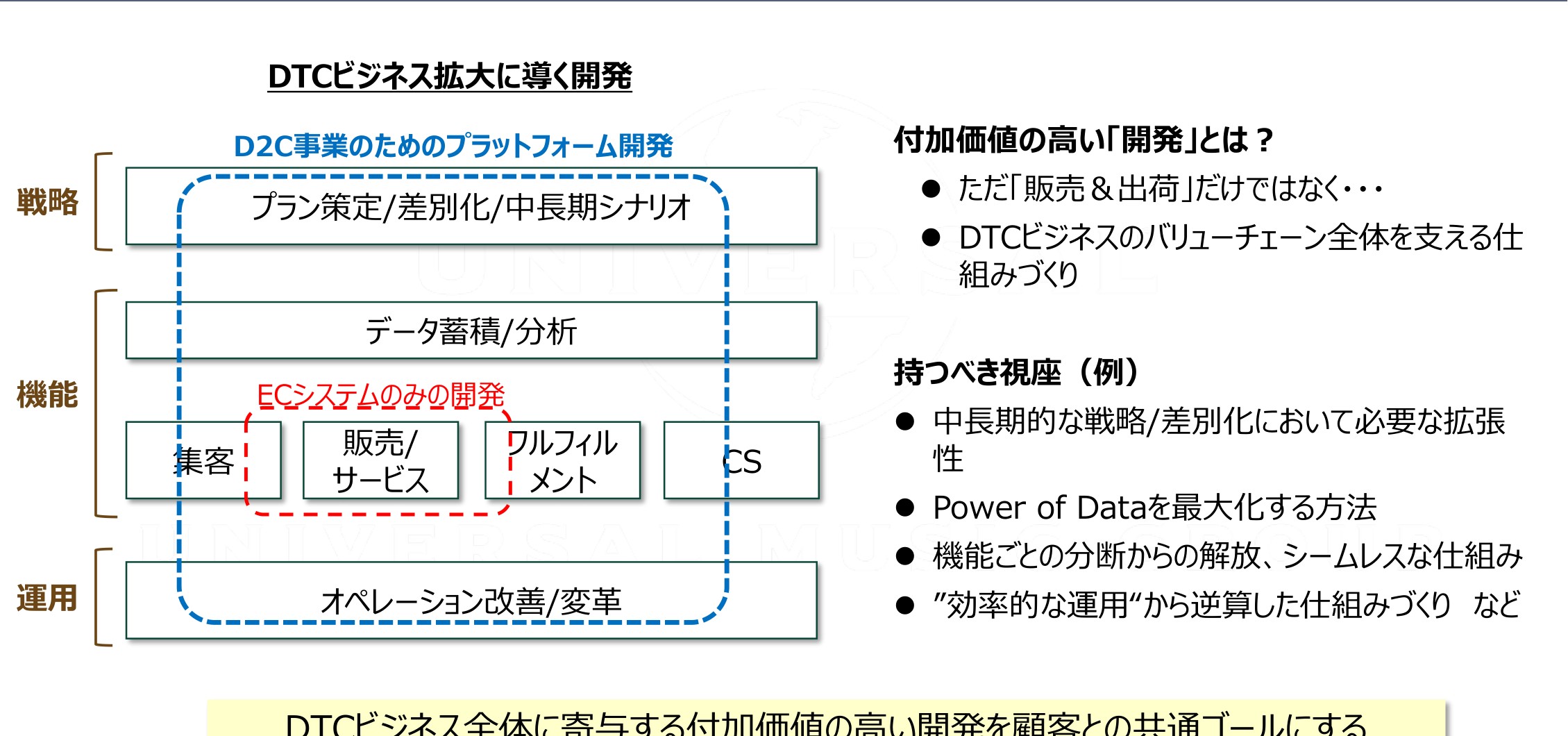
What is High-Value "Development"? Working Backward from the Entire DTC Value Chain
Implementing an EC system is not the goal—it's a means to achieve business growth. To truly elevate a DTC business, you need to support the entire flow—customer acquisition, sales/service, fulfillment, customer support, data accumulation/analysis, and operational improvement/transformation—without fragmentation.
The Perspectives to Have
What becomes important here are "the perspectives to have."
4 Perspectives Supporting Business Growth
- Scalability that supports long-term strategy and differentiation — Not just short-term feature implementation, but design anticipating future business expansion
- Design that maximizes the Power of Data — Systems to accumulate, analyze, and leverage data for decision-making
- Liberation from feature-by-feature fragmentation (seamlessness) — Consistent customer experience from acquisition to sales, fulfillment, and support
- Building systems working backward from "efficient operations" — Operational design the frontline can manage and continuous improvement cycles
Whether you can share the same map with your customer from these perspectives greatly determines vendor added value.
The Growing Role of "Translator" Connecting Domains
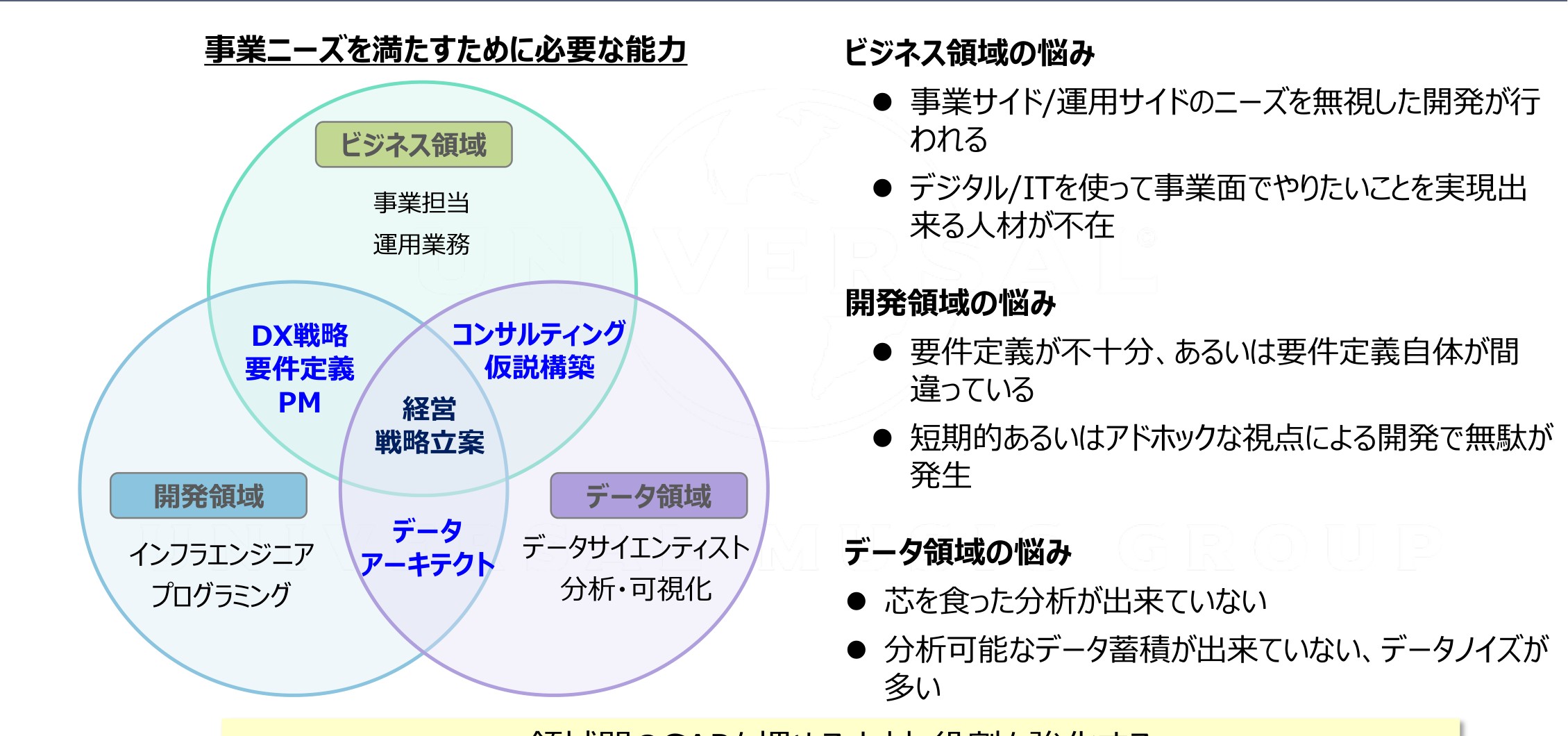
In the field, cases are increasing where business, development, and data domains each try to optimize separately, causing the overall system to misalign.
Typical "three-way deadlock" situation:
- Business side has "what they want to do" but cannot translate how to realize it with IT
- Development side gets overwhelmed by short-term, ad-hoc requirements
- Data side cannot hit the core of analytics
Bridging this gap are "translators" crossing domains—DX strategy, requirements definition, PM, consultative hypothesis building, data architects, etc.
For Shopify vendors strengthening proposal capability, how much talent/function you can have in this area becomes a winning strategy.
Enhancing Customer Communication Elevates "Organizational Capability," Not Just "Sales Capability"
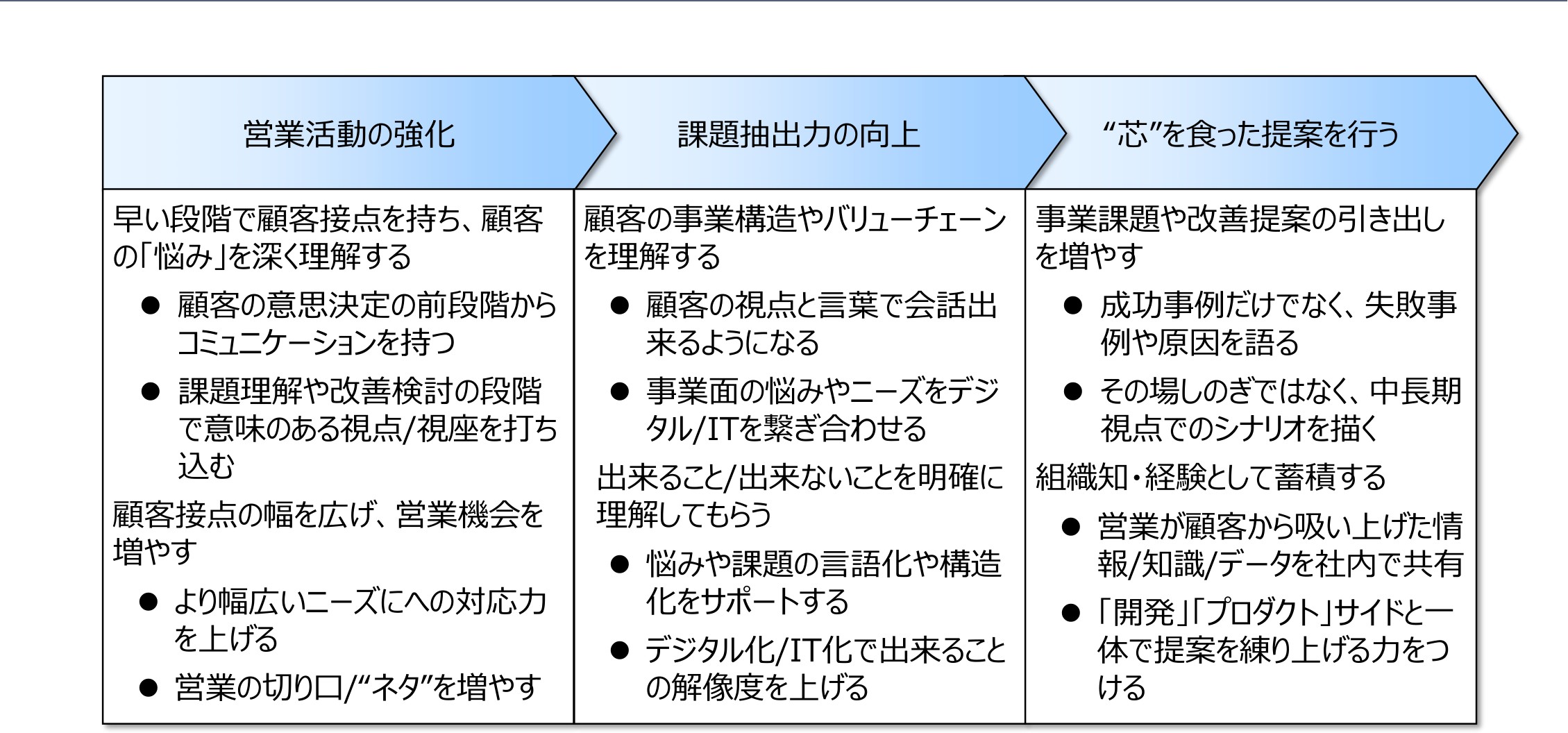
Strengthening proposal capability ultimately depends on depth of customer understanding. The point is having customer touchpoints before decision-making and excavating problem structures together.
The value is not in being an "order-taker," but in injecting meaningful perspectives early in problem understanding and improvement consideration.
Power Gained from Understanding Customer Business Structure
- Can connect business concerns to digital/IT — Translate business issues into technical solutions
- Clarify what's possible/impossible, reducing perception gaps — Setting realistic expectations
- Build a repository of success/failure cases — Sharing best practices learned from past experiences
- Can converse in long-term scenarios, not quick fixes — Elevation to strategic proposals
Design as Organizational Capability
To prevent proposal capability from remaining individual skill, it's effective to design and operate "customer touchpoints," "communication tools," and "accumulation as organizational knowledge" as a set.
3 Elements Elevating Organizational Capability
- Customer touchpoints — Continuous dialogue opportunities and trust building
- Communication tools — Frameworks, templates, visualization tools
- Accumulation as organizational knowledge — Knowledge base, case studies, learning cycles
Summary
In an era where generative AI is changing how all work is done, engineering-focused companies that cannot propose from the same business perspective as customers may already have no reason to exist.
What's required of EC vendors is not just being technology providers, but as business growth partners, understanding the entire value chain and serving as "translators" connecting value across domains.